|
|
| (34 intermediate revisions by 3 users not shown) |
| Line 1: |
Line 1: |
| | SHREYA LAKSHMISHA SPRING 2026 |
| | |
| ==Main Idea== | | ==Main Idea== |
| In many cases, analyzing the kinetic energy of an object is in fact more difficult than just applying the formula <math> K = \cfrac{1}{2}mv^2 </math>. An example of this is when throwing a basketball because not only does it move through the air, but it is also rotating around its own axis. When analyzing more complicated movements like this one, it is necessary to break kinetic energy into different parts, such as rotational, translational, and vibrational, and analyze each one separately to give a more accurate picture. | | In many real-world situations, analyzing the kinetic energy of an object is more complex than just applying the formula: |
|
| |
|
| Translational kinetic energy is the kinetic energy associated with the motion of the center of mass of an object. This would be the basketball traveling in the air from one location to another. While relative kinetic energy is the kinetic energy associated to the rotation or vibration of the atoms of the object around its center or axis. Relative kinetic energy would be the rotation of the basketball around it's axis. Later on this page, we go into more depth about the different types of kinetic energy.
| | <math> K = \cfrac{1}{2}mv^2 </math> |
|
| |
|
| Here is a link to a video which explains kinetic energy in detail: [https://youtu.be/Cobhu3lgeMg]
| | For example when a basketball is thrown, it is not only moving through space, but also rotating about its own axis. Because of this, the total kinetic energy must be broken into components. |
|
| |
|
| ===Mathematical Model===
| | The total kinetic energy of a system can be separated into: |
| === Total Kinetic Energy ===
| | * Translational energy (motion of the center of mass) |
| As we just saw, the total kinetic energy of a multi particle system can be divided into the energy associated with motion of the center of mass and the motion relative to the center of mass.
| | * Rotational energy (spinning motion) |
| | * Vibrational energy (internal motion of particles) |
|
| |
|
| ::<math> K_{total} = K_{translational} + K_{relative} </math>
| | This breakdown allows us to more accurately analyze motion in physical systems. |
|
| |
|
| The relative kinetic energy is composed of motion due to rotation about the center of mass and vibrations/oscillations of the object.
| |
|
| |
|
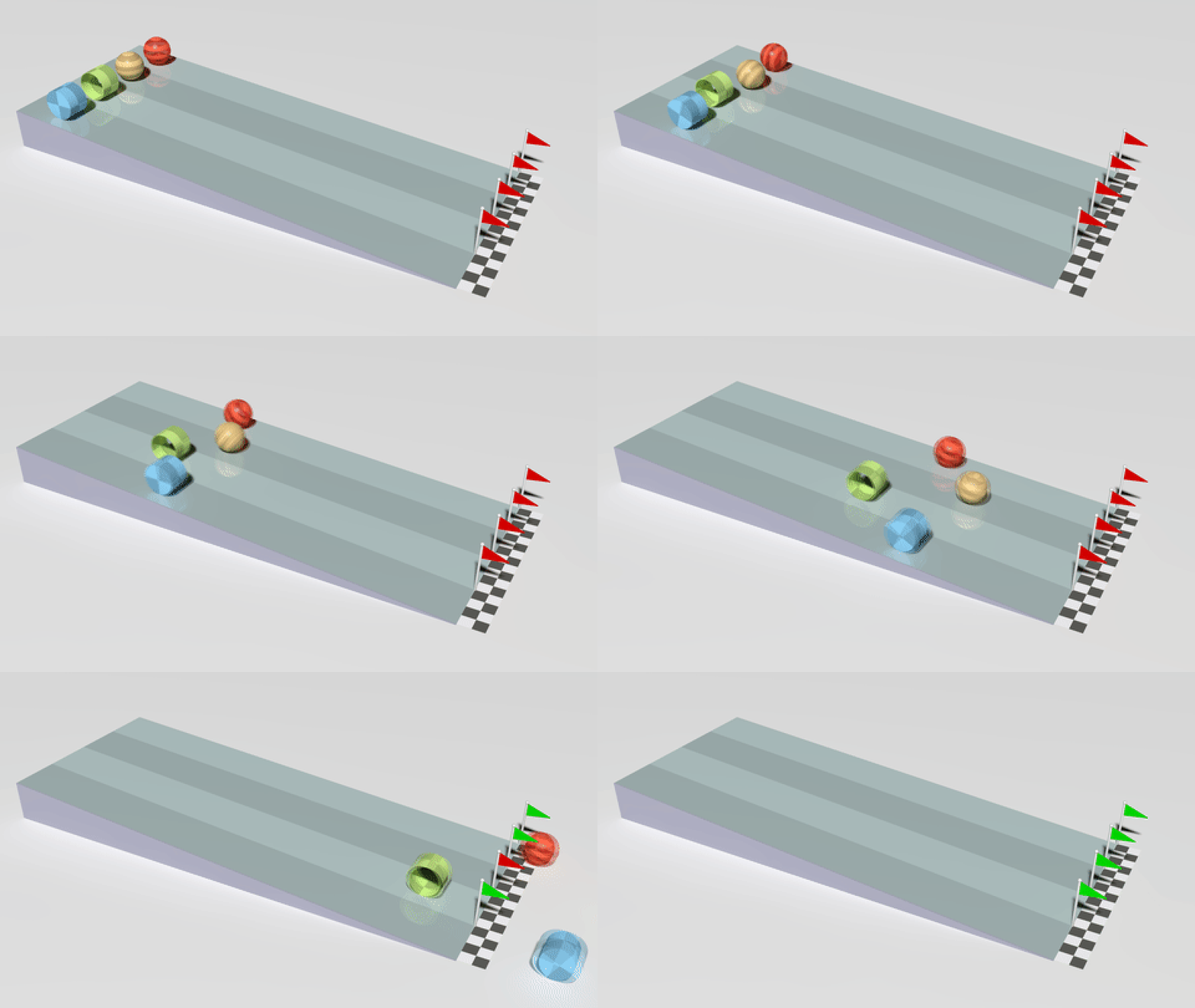
| ::<math> K_{total} = K_{translational} + K_{rotational} + K_{vibrational} </math> | | [[File:Rolling Racers - Moment of inertia.gif|Rolling_Racers_-_Moment_of_inertia]] |
|
| |
|
| ====Translational Kinetic Energy==== | | ===Mathematical Model=== |
| | === Total Kinetic Energy === |
|
| |
|
| "Translation" means:
| | <math>K_{total} = K_{translational} + K_{rotational} + K_{vibrational}</math> |
|
| |
|
| ::''To move from one location to another location''
| | This equation shows that energy must be considered in multiple forms when objects both move and rotate. |
|
| |
|
| By calculating translational kinetic energy, we can track how one object moves from one location to another. Since the translational kinetic energy is associated with the movement of the center of mass of the object, it is important to know how to calculate the location of the center of mass and the velocity of the center of mass which is shown in the two equations below:
| |
|
| |
|
| ::<math>r_{CM} = \cfrac{m_1r_1 + m_2r_2+m_3r_3 + ...}{m_1 + m_2 +m_3}</math>
| | ====Translational Kinetic Energy==== |
| | |
| ::<math>v_{CM} = \cfrac{m_1v_1 + m_2v_2+m_3v_3 + ...}{m_1+ m_2 +m_3}</math>
| |
|
| |
|
| :Here is a link to a video if you want to refresh your knowledge on center of mass: [https://youtu.be/5qwW8WI1gkw] | | ::<math>K_{trans} = \cfrac{1}{2}Mv_{CM}^2</math> |
|
| |
|
| The motion of the center of mass is described by the velocity of the center of mass. Using the total mass and the velocity of the center of mass, we define the translational kinetic energy as:
| | * <math>M</math>: total mass |
| | * <math>v_{CM}</math>: velocity of the center of mass |
|
| |
|
| ::<math>K_{translational} = \cfrac{1}{2}M_{total}v_{CM}^2</math>
| |
|
| |
|
| ====Vibrational Kinetic Energy====
| | The center of mass is calculated as: |
| The total energy due to vibrations is the sum of the potential energy associated with interactions causing the vibrations and the kinetic energy of the vibrations. | |
|
| |
|
| ::<math>E_{vibrational} = K_{vibrational} + U_{s}</math> | | ::<math>r_{CM} = \cfrac{\sum m_ir_i}{\sum m_i}</math> |
| | ::<math>v_{CM} = \cfrac{\sum m_iv_i}{\sum m_i}</math> |
|
| |
|
| The easiest way to find vibrational kinetic energy is by knowing the other energy terms and isolating the vibrational kinetic energy. This is when there is no rotational kinetic energy:
| | '''Key Idea:''' Translational energy depends only on how the object moves. |
|
| |
|
| ::<math>E_{total} = K_{trans} + K_{vibrational} + U_{s} +E_{rest}</math> | | [[File:Beam with pivot P, center of mass S and center of percussion C.svg|Beam_with_pivot_P,_center_of_mass_S_and_center_of_percussion_C]] |
| ::<math>K_{vibrational} = E_{total} - (K_{trans} + U_{s} +E_{rest})</math>
| | --- |
|
| |
|
| ====Rotational Kinetic Energy==== | | ====Rotational Kinetic Energy==== |
| [[File:Kinetic_energy.png|300px|right|thumb|Here are links to two videos that cover rotational kinetic energy and moment of interia: [https://youtu.be/craljBk-E5g][https://youtu.be/XlFlZHfAZeE]]]
| | The total energy due to vibrations is the sum of the potential energy associated with interactions causing the vibrations and the kinetic energy of the vibrations. |
| Rotational kinetic energy is the energy due to the rotation about the center of mass. It can be calculated by finding the angular momentum and inertia of the system, which will be discussed in greater detail in the next two sections. The equation used to find kinetic rotational energy is below:
| |
| | |
| ::<math>K_{rotational} =\frac{1}{2} I_{cm}{\omega}^2</math>
| |
| | |
| Another important rotational equation is:
| |
| | |
| ::<math></math>
| |
| | |
| =====Moment of Inertia=====
| |
| The moment of inertia of an object shows the difficulty of rotating an object, since the larger the moment of inertia the more energy is required to rotate the object at the same angular velocity as an object with a smaller moment of inertia. The moment of inertia of an object is defined as the sum of the products of the mass of each particle in the object with the square of their distance from the axis of rotation. The general formula for calculating the moment of inertia of an object is:
| |
| | |
| ::<math>I = m_1{r_{1}}^2 + m_2{r_{2}}^2 + m_3{r_{3}}^2 +...</math>
| |
|
| |
|
| :::Here <math> r_1, r_2, r_3 </math> represent the perpendicular distance from the point/axis of rotation. | | ::<math>K_{rot} = \cfrac{1}{2}I\omega^2</math> |
|
| |
|
| :or | | * <math>I</math>: moment of inertia |
| | * <math>\omega</math>: angular velocity |
|
| |
|
| ::<math>I = \sum_{i} m_{i}{r_{i}}^2</math>
| | ====Moment of Inertia==== |
|
| |
|
| :For a body with a uniform distribution of mass this can be turned into an integral: | | ::<math>I = \sum m_i r_i^2</math> |
|
| |
|
| ::<math>I = \int r^2 \ dm</math>
| | This measures how difficult it is to rotate an object. |
|
| |
|
| The units of rotational inertia are <math> kg \cdot m^2 </math>
| | '''Important Insight:''' |
| | Mass farther from the axis increases rotational energy because of the \(r^2\) term. |
|
| |
|
| [[File:4c906c92cebe30d9486deb2a682acf561d23c9c1.png|900px|center]]
| |
|
| |
|
| =====Angular Speed=====
| | [[File:Moment of inertia solid sphere.svg|Moment_of_inertia_solid_sphere]] |
| The angular speed is the rate at which the object is rotating. It is given in the following formula:
| |
| [[File:Angularvelocity.png|right|200px]] | |
|
| |
|
| ::<math>\omega = \cfrac{2\pi}{T}</math>, where
| | --- |
|
| |
|
| :::<math>T =</math> the period of the rotation
| | =====Angular Speed and Velocity===== |
|
| |
|
| The angle in which a disk turns is <math>2 \pi</math> in a time <math>T</math>. It is measured in radians per second. The tangential velocity of an object is related to its radius r at the angular speed because the tangential velocity increases when the distance from the center of an object increases. It is shown in the equation below:
| | ::<math>\omega = \cfrac{2\pi}{T}</math> |
|
| |
|
| ::<math>v(r)= \omega r</math> | | ::<math>v = \omega r</math> |
|
| |
|
| ===Computational Model===
| | Points farther from the center move faster. |
| :'''Insert Computational Model here'''
| |
|
| |
|
| ==Examples==
| | --- |
|
| |
|
| ===Simple=== | | =====Vibrational Kinetic Energy===== |
|
| |
|
| ===Middling===
| | Vibrational energy comes from internal motion of particles within an object. |
|
| |
|
| ===Difficult===
| | * Important in molecules and thermal systems |
| | * Usually not directly calculated in introductory physics problems |
|
| |
|
| ==Connectedness==
| | --- |
| '''1. How is this topic connected to something that you are interested in?'''
| |
|
| |
|
| *This topic connected to me because I used to dance when I was younger. This section focused on kinetic energy and the different parts of kinetic energy. You could break up different parts of dance and compare it to kinetic energy.
| | ===Physical Intuition=== |
| | Consider a rolling wheel: |
|
| |
|
| '''2. How is it connected to your major?'''
| | * Moves forward -> translational energy |
| | | * Spins -> rotational energy |
| *In Chemical Engineering, we will focus on the kinetic energy on the microscopic level and determining the energy of the particles by looking at the translational, rotational, and vibrational energies of the atom, and how they allow chemical reactions to precess. | | * Internal atoms vibrate -> vibrational energy |
| | |
| '''3. Is there an interesting industrial application?'''
| |
| | |
| *There are many machines that use kinetic energy for power, and we will probably see in a few years from now the use of rotational, translational, and vibrational energy to power anything from phones to computers. | |
| | |
| ==History==
| |
| Kinetic energy was first set apart from potential energy by Aristotle. Later, in the 1600's, Leibniz and Bernoulli developed the idea that <math>E \propto mv^2</math>, and they called it the 'living force.' However, it wasn't until 1829 that Gaspard-Gustave Coriolis showed the first signs of understanding kinetic energy the way that we do today by focusing on the transfer on energy in rotating water wheels. Finally, in 1849, Lord Kelvin is said to have coined the term 'kinetic energy.'
| |
| | |
| ==See also==
| |
| | |
| ===Further Reading===
| |
| *[[Point Particle Systems]]<br>
| |
| *[[Real Systems]]<br>
| |
| *[[Conservation of Energy]]<br>
| |
| *[[Potential Energy]]<br> | |
| *[[Thermal Energy]]<br>
| |
| *[[Internal Energy]]<br>
| |
| *[[Center of Mass]]<br>
| |
| | |
| ===External Links===
| |
| *https://www.youtube.com/watch?v=5qwW8WI1gkw&feature=youtu.be<br>
| |
| *https://youtu.be/Cobhu3lgeMg<br>
| |
| *https://www.youtube.com/watch?v=craljBk-E5g&feature=youtu.be<br>
| |
| *https://youtu.be/XlFlZHfAZeE<br>
| |
| *https://youtu.be/vL5yTCyRMGk<br>
| |
| *https://en.wikipedia.org/wiki/Kinetic_energy<br>
| |
| *https://en.wikipedia.org/wiki/Moment_of_inertia<br>
| |
| *https://www.khanacademy.org/science/physics/torque-angular-momentum/torque-tutorial/a/rotational-inertia<br>
| |
| *https://youtu.be/vL5yTCyRMGk
| |
| | |
| ==References==
| |
| All problem examples, youtube videos, and images are from the websites referenced below:
| |
| | |
| *http://p3server.pa.msu.edu/coursewiki/doku.php?id=183_notes:energy_sep
| |
| | |
| *https://cnx.org/contents/1Q9uMg_a@6.4:V7Fr-AEP@3/103-Relating-Angular-and-Trans
| |
| | |
| *https://en.wikipedia.org/wiki/Gaspard-Gustave_de_Coriolis
| |
|
| |
|
| ==Examples== | | ==Examples== |
|
| |
|
| ===Simple=== | | ===Conceptual Example=== |
|
| |
|
| A player throws a mid-court pass horizontally with a <math>624g</math> basketball. This pass covers <math>15 \ m</math> in <math>2 \ s</math>. | | A bowling ball rolls without slipping. |
|
| |
|
| :'''a) What is the basketball’s average translational kinetic energy while in flight?
| | '''Which energies are present?''' |
|
| |
|
| ::Since the ball is moving relative to the gym, we can describe its average velocity, and thus translational kinetic energy as:
| | * Translational ✔ |
| | * Rotational ✔ |
| | * Vibrational ✖ (ignored at this level) |
|
| |
|
| :::<math>v_{avg} = \frac{d}{t} = \frac{15}{2} = 7.5 \ \frac{m}{s}</math>
| | --- |
|
| |
|
| :::<math>K_{avg_{b}} = \frac{1}{2}m{v_{avg}}^2 = \frac{1}{2} \times 0.624 \times (7.5)^2 = 17.55 \ J</math>
| | ===Calculation Example=== |
|
| |
|
| An average molecule of air in the basketball, has a mass of <math>29 \ u</math>, and an average speed of <math>500 \ \frac{m}{s}</math>, relative to the basketball. There are about <math>3 \times 10^{23}</math> molecules inside it, moving in random directions, when the ball is properly inflated.
| | A solid disk rolls without slipping. |
|
| |
|
| :'''b) What is the average translational kinetic energy of the random motion of all the molecules inside, relative to the basketball? | | Given: |
| | * <math>m = 2 \, kg</math> |
| | * <math>v = 3 \, \frac{m}{s}</math> |
| | * <math>I = \cfrac{1}{2}mr^2</math> |
|
| |
|
| ::Since the average speed of a molecule is <math>500 \ \frac{m}{s}</math>, we can calculate the average translational kinetic energy of a given molecule: | | Step 1: Translational Energy |
|
| |
|
| :::<math>K_{avg_{g}} = \frac{1}{2}m_{g}{v_{avg_{g}}}^2</math>
| | ::<math>K_{trans} = \cfrac{1}{2}mv^2 = 9 \, J</math> |
|
| |
|
| ::The mass of a molecule in kilograms <math>(m_{g})</math> will be the atomic mass <math>(m_{A})</math> times a conversion factor <math>(A)</math>: | | Step 2: Rotational Energy |
|
| |
|
| :::<math>m_{g} = m_{A}A = 29 \times 1.66 \times 10^{-27} = 4.814 \times 10^{-26} \ kg</math>
| | ::<math>K_{trans} = \cfrac{1}{2}mv^2 = 9 \, J</math> |
|
| |
|
| ::Thus, the translational kinetic energy of an average molecule relative to the ball is:
| | Using <math>\omega = \cfrac{v}{r}</math>: |
|
| |
|
| :::<math>K_{avg_{g}} = \frac{1}{2}m_{g}{v_{avg_{g}}}^2 = \frac{1}{2} \times 4.814 \times 10^{-26} \times (500)^2 = 6.0175 \times 10^{-21} \ J</math>
| | ::<math>K_{rot} = \cfrac{1}{4}mv^2 = 4.5 \, J</math> |
|
| |
|
| ::Multiplying this kinetic energy by the number of molecules will give us our answer:
| | Total Energy: |
|
| |
|
| :::<math>K_{avg_{total}} = N K_{avg_{g}} = 3 \times 10^{23} \times 6.0175 \times 10^{-21} = 1,805.25 \ J</math>
| | ::<math>K_{total} = 13.5 \, J</math> |
|
| |
|
| ::The kinetic energy possessed by the gas relative to the ball is <math>1,805.25</math> Joules.
| | --- |
|
| |
|
| :'''c) How fast would the basketball have to travel relative to the court to have a kinetic energy equal to the amount in part (b)?
| | ===Common Mistakes=== |
|
| |
|
| ::The basketball would have to have a translational kinetic energy equal to <math>1,805.25</math> Joules. To do this the ball's speed would have to satisfy:
| | * Forgetting rotational energy in rolling problems |
| | * Using incorrect relationship between \(v\) and \(\omega\) |
| | * Ignoring moment of inertia differences |
| | * Assuming only translational motion matters |
|
| |
|
| :::<math>K_{ball} = \frac{1}{2}m_{ball}v^2</math>
| | --- |
|
| |
|
| ::Solving for <math>v</math> gives:
| | ==Computational Model== |
|
| |
|
| :::<math>v = \sqrt{\frac{2K_{ball}}{m_{ball}}} = \sqrt{\frac{2 \times 1,805.25}{0.624}} = 76.07 \ \frac{m}{s}</math> | | GlowScript simulation: |
|
| |
|
| ===Middling===
| | https://trinket.io/glowscript/31d0f9ad9e |
| ''Problem statement'':
| |
|
| |
|
| In the figure, a wheel is mounted on a stationary axel, which is nearly frictionless so that the wheel turns freely. The wheel has an inner ring with a mass of <math>5 \ kg</math> and a radius of <math>10 \ cm</math>, and an outer ring with a mass of <math>2 \ kg</math> and a radius of <math>25 \ cm</math>; the spokes have negligible mass. A string with negligible mass is wrapped around the outer ring and you pull on it, increasing the rotational speed of the wheel.
| | This model helps visualize rotational motion and energy changes. |
|
| |
|
| :'''a) During the time that the wheel's rotation changes from 4 revolutions per second to 7 revolutions per second, how much work do you do?'''
| | --- |
|
| |
|
| ::
| | ==Connectedness== |
|
| |
|
| "Facts":
| | '''Personal Connection:''' |
| | Dance and sports like tennis involve rotation and motion, similar to energy concepts discussed here. |
|
| |
|
| Inner ring of wheel has mass of 5 kg and radius 10 cm
| | '''Academic Connection:''' |
| Outer ring has a mass of 2 kg and radius of 25 cm
| | Important in physics, engineering, and chemistry for analyzing motion and energy systems. |
| String with negligible mass is wrapped around the outer rung and pulled out
| |
|
| |
|
| "Assumption and Approximations":
| | '''Industrial Applications:''' |
| | * Flywheels for energy storage |
| | * Rotating machinery |
| | * Engines and turbines |
|
| |
|
| The rod has to be sufficiently thin so your not worried about contributions to the moment of inertia from parts of the rod that are further away from the center of mass.
| | --- |
| Stationary axle is nearly frictionless so that the wheel turns freely.
| |
| The spokes of the wheel have negligible mass.
| |
| String wrapped around the outer ring has negligible mass.
| |
|
| |
|
| "Representations"
| | ===History=== |
|
| |
|
| System: Wheel and string
| | The concept of kinetic energy developed over time through contributions from scientists such as Aristotle, Leibniz, Bernoulli, and Gaspard-Gustave Coriolis. The term “kinetic energy” was later coined by Lord Kelvin. |
| Surroundings: Your hand, axle, Earth
| |
|
| |
|
| [[File:Rotational_kietnic_energy_problem.jpg]]
| | ===Why This Matters for Exams=== |
|
| |
|
| ''Solution'':
| | Most physics problems: |
| | * Combine translation and rotation |
| | * Require identifying ALL forms of energy |
|
| |
|
| From the Energy Principle: <math>E_f=E_i+W</math>
| | Missing one energy component often leads to incorrect answers. |
|
| |
|
| Substitute in equation for rotational energy for energy initial and energy final.
| | --- |
|
| |
|
| <math>1/2Iω_f^2=1/2Iω_i^2+W </math>
| | ===Summary=== |
|
| |
|
| <math>W=1/2I(ω_f^2−ω_i^2) </math>
| | Kinetic energy in real systems consists of multiple components. By separating it into translational, rotational, and vibrational parts, we can more accurately understand and analyze motion. |
|
| |
|
| What is the moment of inertia?
| | ==References== |
| Group this sum into a part that includes just the atoms of the inner ring and another part that includes just the atoms of the outer ring:
| |
| | |
| <math>I=(mr{⊥1}^2 + m_2r_{⊥2}^2+ ⋅⋅⋅)inner+ (m_1r_{⊥1}^2+ m_2r_{⊥2}^2)outer + ⋅⋅⋅</math>
| |
| | |
| The total inertia is then the inertia inner + the inertia outer (I=Iinner+Iouter) This is a general result: The moment of inertia of a composite object is the sum of the moments of inertia of the individual pieces, because we have to add up all the contributions of all the atoms. We already determined that the moment of inertia of a ring is <math>MR^2</math> (all the atoms are at the same perpendicular distance R from the center), so the moment of inertia of this wheel is:
| |
| | |
| <math>I=M_{inner}R_{inner}^2+M_{outer}R_{outer}^2</math>
| |
| | |
| Substitute the corresponding values for the variables:
| |
| | |
| <math>I=(5kg)(.1m)^2+ (2kg)(.25m)^2= (0.050+0.125)kg⋅m^2=0.175kg⋅m^2 </math>
| |
| | |
| We need to convert revolutions per second into radians per second:
| |
| | |
| <math>ω_i=(4revs)(2πradians/rev)=25.1 radians/s</math>
| |
| | |
| <math> ω_f=(7revs)(2πradians/rev)=44.0 radians/s </math>
| |
| | |
| You, the Earth, and the axle will exert forces on the system. How much work does the Earth do? Zero, because the center of mass of the wheel doesn't move. How much work does the axle do? If there is negligible friction between the axle and the wheel, the axle does no work, because there is no-displacement of the axle's force. Therefore only you do work, and the work that you do is:
| |
| | |
| <math>W=1/2(0.175kg⋅m^2)(44.02+25.12)radians^2s^2=114J</math>
| |
| | |
| ===Difficult===
| |
| ''Problem statement''
| |
| You're playing with a yo-yo of mass m on a low-mass string. You pull up on the string with a force of magnitude F, and your hand moves up a distance d. During this time the mass falls a distance h (and some of the string reels off the yo-yo's axle). (a) What is the change in translational kinetic energy of the yo-yo? (b) What is the change in the rotational kinetic energy of the yo-yo, which spins faster?
| |
| | |
| "Assumptions and Approximations"
| |
| able to maintain constant force when pulling up on yo-yo
| |
| no slippage of string around axis
| |
| sprinkle turns the same amount as string that has unraveled
| |
| no wobble included
| |
| string has no mass
| |
| | |
| | |
| a.
| |
| ''Facts and Representations''
| |
| Initial State: point particle with initial translational kinetic energy
| |
| Final State: Point Particle with final translational Kinetic energy
| |
| Point Particle System
| |
| System: Point Particle of mass m
| |
| Surroundings: Hand and earth
| |
| | |
| [[File:Yoyopointparticle.jpg]]
| |
| | |
| "Solution"
| |
| | |
| From the Energy Principle ( when dealing with a point particle it only has Ktrans):
| |
| | |
| ΔKtrans= ∫F⃗ net⋅dr⃗ cm
| |
| | |
| Substituting in for the forces acting on the yo-yo for Fnet and the change in position in the y direction for the centre of mass for dr⃗ cm we get:
| |
| | |
| ΔKtrans=(F−mg)ΔyCM
| |
| | |
| As indicated in diagram in the b section of the representation:
| |
| | |
| ΔyCM=−h (Substitute in −h for yCM)
| |
| | |
| ΔKtrans=(F−mg)(−h)
| |
| | |
| Multiply across by a minus and you get an equation for ΔKtrans that looks like:
| |
| | |
| ΔKtrans=(mg−F)h
| |
| | |
| b.
| |
| "Facts and Representation"
| |
| Initial State: Initial rotational and translational kinetic energy
| |
| Final State: Final rotational and translational kinetic energy
| |
| Real system
| |
| System: Mass and String
| |
| Surroundings: Earth and hand
| |
| | |
| [[File:Extenedsystemyoyo.jpg]]
| |
| | |
| "Solution"
| |
| From the energy principle we know:
| |
| | |
| ΔEsys = Wsurr
| |
| | |
| In this case we know that the change in energy in the system is due to the work done by the hand and the work done by the Earth.
| |
| | |
| ΔEsys=Whand+WEarth
| |
| | |
| Because we are dealing with the real system in this scenario the change in energy is equal to the change in translational kinetic energy + the change in rotational kinetic energy.
| |
| | |
| ΔKtrans+ΔKrot=Whand+WEarth
| |
| | |
| Substitute in the work represented by force by distance for both the hand and the Earth.
| |
| | |
| ΔKtrans+ΔKrot=Fd+(−mg)(−h)
| |
|
| |
|
| From part (a) of the problem we can substitute in (mg−F)h for ΔKtrans as the translational kinetic energy will be the same.
| | *https://openstax.org/details/books/university-physics-volume-1 |
|
| |
|
| ΔKtrans=(mg−F)h
| | *https://www.khanacademy.org/science/physics/work-and-energy |
|
| |
|
| Substituting this into our equation leaves us with:
| | *https://en.wikipedia.org/wiki/Kinetic_energy |
|
| |
|
| (mg−F)h+ΔKrot=Fd+mgh
| | *https://en.wikipedia.org/wiki/Moment_of_inertia |
|
| |
|
| Solve for change in rotational kinetic energy:
| | *https://trinket.io/glowscript/ |
|
| |
|
| ΔKrot=F(d+h)
| | *https://ocw.mit.edu/courses/physics/ |
SHREYA LAKSHMISHA SPRING 2026
Main Idea
In many real-world situations, analyzing the kinetic energy of an object is more complex than just applying the formula:
[math]\displaystyle{ K = \cfrac{1}{2}mv^2 }[/math]
For example when a basketball is thrown, it is not only moving through space, but also rotating about its own axis. Because of this, the total kinetic energy must be broken into components.
The total kinetic energy of a system can be separated into:
- Translational energy (motion of the center of mass)
- Rotational energy (spinning motion)
- Vibrational energy (internal motion of particles)
This breakdown allows us to more accurately analyze motion in physical systems.
Mathematical Model
Total Kinetic Energy
[math]\displaystyle{ K_{total} = K_{translational} + K_{rotational} + K_{vibrational} }[/math]
This equation shows that energy must be considered in multiple forms when objects both move and rotate.
Translational Kinetic Energy
- [math]\displaystyle{ K_{trans} = \cfrac{1}{2}Mv_{CM}^2 }[/math]
- [math]\displaystyle{ M }[/math]: total mass
- [math]\displaystyle{ v_{CM} }[/math]: velocity of the center of mass
The center of mass is calculated as:
- [math]\displaystyle{ r_{CM} = \cfrac{\sum m_ir_i}{\sum m_i} }[/math]
- [math]\displaystyle{ v_{CM} = \cfrac{\sum m_iv_i}{\sum m_i} }[/math]
Key Idea: Translational energy depends only on how the object moves.
 ---
---
Rotational Kinetic Energy
The total energy due to vibrations is the sum of the potential energy associated with interactions causing the vibrations and the kinetic energy of the vibrations.
- [math]\displaystyle{ K_{rot} = \cfrac{1}{2}I\omega^2 }[/math]
- [math]\displaystyle{ I }[/math]: moment of inertia
- [math]\displaystyle{ \omega }[/math]: angular velocity
Moment of Inertia
- [math]\displaystyle{ I = \sum m_i r_i^2 }[/math]
This measures how difficult it is to rotate an object.
Important Insight:
Mass farther from the axis increases rotational energy because of the \(r^2\) term.

---
Angular Speed and Velocity
- [math]\displaystyle{ \omega = \cfrac{2\pi}{T} }[/math]
- [math]\displaystyle{ v = \omega r }[/math]
Points farther from the center move faster.
---
Vibrational Kinetic Energy
Vibrational energy comes from internal motion of particles within an object.
- Important in molecules and thermal systems
- Usually not directly calculated in introductory physics problems
---
Physical Intuition
Consider a rolling wheel:
- Moves forward -> translational energy
- Spins -> rotational energy
- Internal atoms vibrate -> vibrational energy
Examples
Conceptual Example
A bowling ball rolls without slipping.
Which energies are present?
- Translational ✔
- Rotational ✔
- Vibrational ✖ (ignored at this level)
---
Calculation Example
A solid disk rolls without slipping.
Given:
- [math]\displaystyle{ m = 2 \, kg }[/math]
- [math]\displaystyle{ v = 3 \, \frac{m}{s} }[/math]
- [math]\displaystyle{ I = \cfrac{1}{2}mr^2 }[/math]
Step 1: Translational Energy
- [math]\displaystyle{ K_{trans} = \cfrac{1}{2}mv^2 = 9 \, J }[/math]
Step 2: Rotational Energy
- [math]\displaystyle{ K_{trans} = \cfrac{1}{2}mv^2 = 9 \, J }[/math]
Using [math]\displaystyle{ \omega = \cfrac{v}{r} }[/math]:
- [math]\displaystyle{ K_{rot} = \cfrac{1}{4}mv^2 = 4.5 \, J }[/math]
Total Energy:
- [math]\displaystyle{ K_{total} = 13.5 \, J }[/math]
---
Common Mistakes
- Forgetting rotational energy in rolling problems
- Using incorrect relationship between \(v\) and \(\omega\)
- Ignoring moment of inertia differences
- Assuming only translational motion matters
---
Computational Model
GlowScript simulation:
https://trinket.io/glowscript/31d0f9ad9e
This model helps visualize rotational motion and energy changes.
---
Connectedness
Personal Connection:
Dance and sports like tennis involve rotation and motion, similar to energy concepts discussed here.
Academic Connection:
Important in physics, engineering, and chemistry for analyzing motion and energy systems.
Industrial Applications:
- Flywheels for energy storage
- Rotating machinery
- Engines and turbines
---
History
The concept of kinetic energy developed over time through contributions from scientists such as Aristotle, Leibniz, Bernoulli, and Gaspard-Gustave Coriolis. The term “kinetic energy” was later coined by Lord Kelvin.
Why This Matters for Exams
Most physics problems:
- Combine translation and rotation
- Require identifying ALL forms of energy
Missing one energy component often leads to incorrect answers.
---
Summary
Kinetic energy in real systems consists of multiple components. By separating it into translational, rotational, and vibrational parts, we can more accurately understand and analyze motion.
References

 ---
---
