|
|
| (126 intermediate revisions by 5 users not shown) |
| Line 1: |
Line 1: |
| Claimed by Ferguson Beardsley Fall 2017
| | SHREYA LAKSHMISHA SPRING 2026 |
| | |
| ==Main Idea== | | ==Main Idea== |
| | In many real-world situations, analyzing the kinetic energy of an object is more complex than just applying the formula: |
|
| |
|
| In many cases, analyzing the kinetic energy of an object is in fact more difficult than just applying the formula <math> K = \cfrac{1}{2}mv^2 </math>. An example of this is when throwing a basketball because not only does it move through the air but it is also rotating around its own axis. When analyzing more complicated movements like this one, it is necessary to break kinetic energy into different parts, such as rotational, translational, and vibrational, and analyze each one separately.
| | <math> K = \cfrac{1}{2}mv^2 </math> |
|
| |
|
| | For example when a basketball is thrown, it is not only moving through space, but also rotating about its own axis. Because of this, the total kinetic energy must be broken into components. |
|
| |
|
| Translational kinetic energy is the kinetic energy associated with the motion of the center of mass of an object. This would be the basketball traveling in the air from one location to another. While relative kinetic energy is the kinetic energy associated to the rotation or vibration of the atoms of the object around its center or axis. Relative kinetic energy would be the rotation of the basketball around it's axis. Later on this page, we go into more depth about the different types of kinetic energy.
| | The total kinetic energy of a system can be separated into: |
| | * Translational energy (motion of the center of mass) |
| | * Rotational energy (spinning motion) |
| | * Vibrational energy (internal motion of particles) |
|
| |
|
| Here is a link to a video which explains the break into more detail: [https://youtu.be/Cobhu3lgeMg]
| | This breakdown allows us to more accurately analyze motion in physical systems. |
|
| |
|
| ===A Mathematical Model===
| |
| ==== Total Kinetic Energy ====
| |
| As we just saw, kinetic energy can be divided into two energies: translational kinetic energy and relative kinetic energy. Therefore, the total kinetic energy of a system is equal to the sum of those two kinetic energies:
| |
|
| |
|
| <math> K_{total} = K_{translational} + K_{relative} </math>
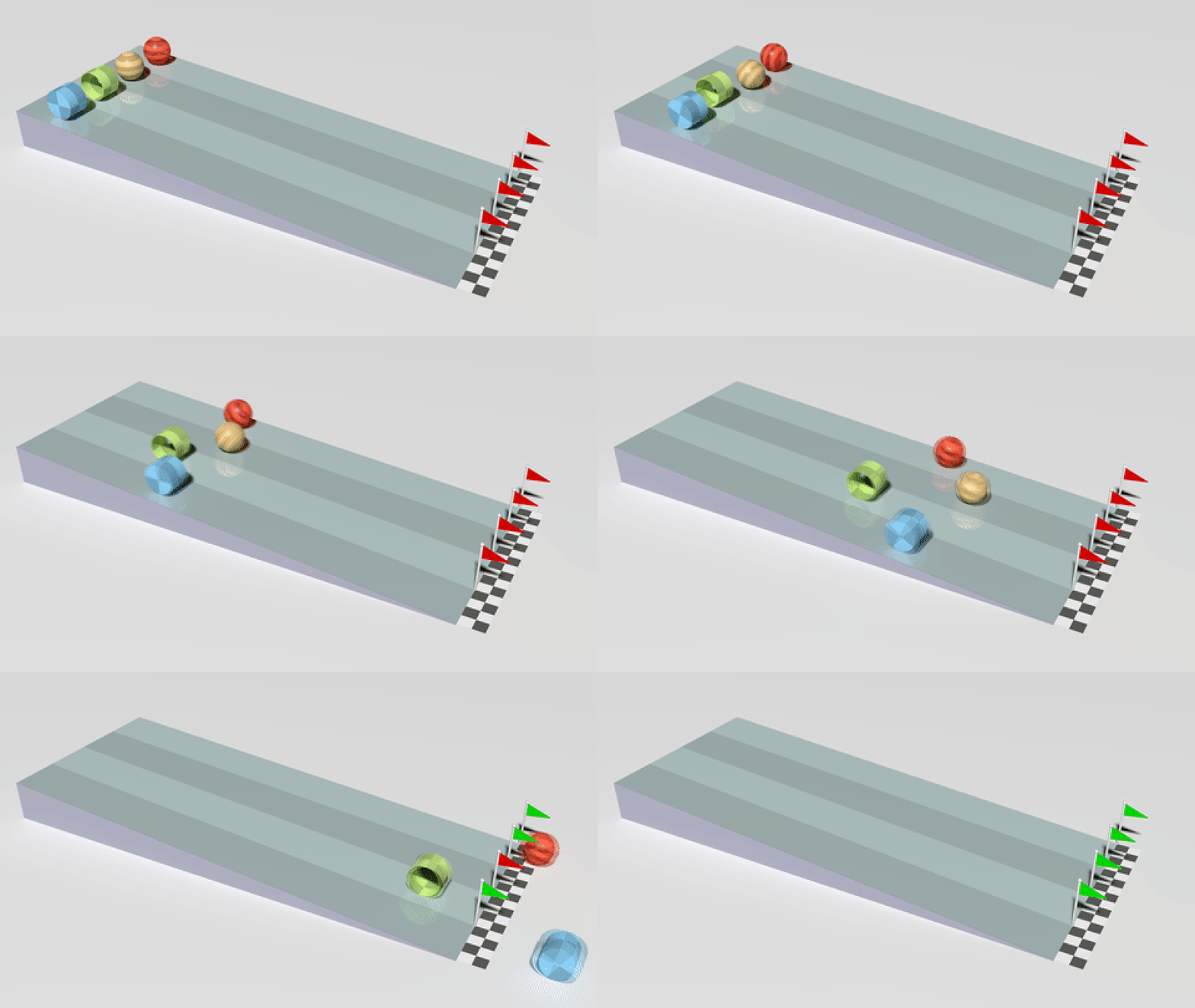
| | [[File:Rolling Racers - Moment of inertia.gif|Rolling_Racers_-_Moment_of_inertia]] |
|
| |
|
| The relative kinetic energy term can itself be divided into two other terms. The energy of the atoms of the object relative to its center or axis can either be rotational (this is the case of the football thrown in the air) or vibrational, or both. Therefore, we have:
| | ===Mathematical Model=== |
| | === Total Kinetic Energy === |
|
| |
|
| <math> K_{total} = K_{translational} + K_{relative} = K_{translational} + K_{rotational} + K_{vibrational} </math> | | <math>K_{total} = K_{translational} + K_{rotational} + K_{vibrational}</math> |
|
| |
|
| ====Calculating Translational Kinetic Energy====
| | This equation shows that energy must be considered in multiple forms when objects both move and rotate. |
|
| |
|
| Because the translational kinetic energy is associated to the movement of the center of mass of the object, it is important to know how to calculate the location of the center of mass.
| |
|
| |
|
| <math> r_{CM} = \cfrac{m_1r_1 + m_2r_2+m_3r_3 + ...}{Mass} </math>
| | ====Translational Kinetic Energy==== |
|
| |
|
| The velocity of the center of mass is given by the equation:
| | ::<math>K_{trans} = \cfrac{1}{2}Mv_{CM}^2</math> |
|
| |
|
| <math> v_{CM} = \cfrac{m_1v_1 + m_2v_2+m_3v_3 + ...}{Mass} </math> | | * <math>M</math>: total mass |
| | * <math>v_{CM}</math>: velocity of the center of mass |
|
| |
|
| Using the total mass and the velocity of the center of mass, we can thus calculate the translational energy of an object:
| |
|
| |
|
| <math> K_{translational} = \cfrac{1}{2}M_{total}v_{CM}^2 </math>
| | The center of mass is calculated as: |
|
| |
|
| ====Calculating Rotational Kinetic Energy==== | | ::<math>r_{CM} = \cfrac{\sum m_ir_i}{\sum m_i}</math> |
| | ::<math>v_{CM} = \cfrac{\sum m_iv_i}{\sum m_i}</math> |
|
| |
|
| Similarly, we can calculate rotational kinetic energy with the following formula:
| | '''Key Idea:''' Translational energy depends only on how the object moves. |
|
| |
|
| <math> K_{rotational} = \cfrac{1}{2}M_{total}v_{CM}^2 </math>
| | [[File:Beam with pivot P, center of mass S and center of percussion C.svg|Beam_with_pivot_P,_center_of_mass_S_and_center_of_percussion_C]] |
| | --- |
|
| |
|
| =====Calculating Moment of Inertia===== | | ====Rotational Kinetic Energy==== |
| | The total energy due to vibrations is the sum of the potential energy associated with interactions causing the vibrations and the kinetic energy of the vibrations. |
|
| |
|
| But rotational kinetic energy can also be calculated with the moment of inertia and the angular speed of an object. The moment of inertia of an object is the sum of the products of the mass of each particle in the object with the square of their distance from the axis of rotation. The general formula for calculating the moment of inertia of an object is:
| | ::<math>K_{rot} = \cfrac{1}{2}I\omega^2</math> |
|
| |
|
| <math> I = m_1r_{\perp,1}^2 + m_2r_2{\perp,2}^2 + m_3r_{\perp,3}^2 +...</math> <math> kg.m^2 </math> | | * <math>I</math>: moment of inertia |
| | * <math>\omega</math>: angular velocity |
|
| |
|
| Here <math> r_1, r_2, r_3 </math> represent the perpendicular distance from the point/axis of rotation.
| | ====Moment of Inertia==== |
| Moment of Inertia is actually calculated using Calculus. These values we obtain for standard objects are not once you will need to derive, but conceptually understanding how they come to be will help you understand Moment of Inertia and it's impact on a solid.
| |
|
| |
|
| The reason we use density in the the calculations is because for uniform solids density is constant throughout the material, implying it has even mass distribution.
| | ::<math>I = \sum m_i r_i^2</math> |
|
| |
|
| [[File:MomentOfInertiaRod1.jpg]]
| | This measures how difficult it is to rotate an object. |
| [[File:MomentOfInertiaRod2.jpg]]
| |
| [[File:MomentOfInertiaCylinder1.jpg]]
| |
| [[File:MomentOfInertiaCylinder2.jpg]]
| |
|
| |
|
| This is to give you an intuitive idea about how Moment of Inertia is calculated, not that you will have to. But an interesting thing it tells you is that when you compare two bodies rotating with the same kinetic energy and one of them has a higher moment of Inertia, then the one with the higher moment of Inertia has a lower speed since <math> w </> must be lower. If <math> w </math> is lower and radius is higher that means mass must be low since Moment of Inertia also depends on mass and distance from axis of rotation. So we can deduce such relations which helps us understand how the moment of Inertia of an object actually affects the object in different ways.
| | '''Important Insight:''' |
| | Mass farther from the axis increases rotational energy because of the \(r^2\) term. |
|
| |
|
| Use this to try and derive the Moment Of Inertia for some other objects you know. ( Sphere is a little challenging )
| |
|
| |
|
| [[File:MomentOfInert.jpg]] | | [[File:Moment of inertia solid sphere.svg|Moment_of_inertia_solid_sphere]] |
| [[File:MomentOfInert22.jpg]]
| |
|
| |
|
| ===== Angular Speed =====
| | --- |
|
| |
|
| The angular speed is a calculation of how fast the object is rotating. It can be calculated from the period, T, with the following formula : <math> \omega = \cfrac{2\pi}{T} </math>
| | =====Angular Speed and Velocity===== |
|
| |
|
| The rotational kinetic energy can thus be calculated using these two variables: <math> K_{rotational} = \cfrac{1}{2}I\omega^2 </math>.
| | ::<math>\omega = \cfrac{2\pi}{T}</math> |
|
| |
|
| ==== Point Particle System VS Extended System ==== | | ::<math>v = \omega r</math> |
|
| |
|
| Why is it useful to divide the kinetic energy into two different elements? When calculating the total energy of a system, depending on how it is modeled, it will contain one or more types of kinetic energies. Let's think about a system modeled as a point particle system. In this model of a system, we think of the object as one point, located at its center of mass. With this way of thinking, it becomes clear that there can only be one type of kinetic energy: translational kinetic energy. There cannot be any rotational kinetic energy because there are no atoms rotating about the center of mass, since we are thinking of the center of mass as the entire object. Our general energy equation thus boils down to this:
| | Points farther from the center move faster. |
|
| |
|
| <math> \triangle E_{system} = W </math> where <math> W = F_{net} . \triangle r_{CM} </math> and <math> \triangle E_{system} = \triangle K_{translational} </math> since there is only translational kinetic energy.
| | --- |
|
| |
|
| We end up with <math> \triangle K_{translational} = F_{net} . \triangle r_{CM} </math>
| | =====Vibrational Kinetic Energy===== |
|
| |
|
| Note: There may also be spring potential energy and rest energy depending on the example.
| | Vibrational energy comes from internal motion of particles within an object. |
|
| |
|
| | * Important in molecules and thermal systems |
| | * Usually not directly calculated in introductory physics problems |
|
| |
|
| Therefore, viewing a system as a point particle system allows us to easily calculate the translational kinetic energy. This translational kinetic energy will be the same in the extended system.
| | --- |
|
| |
|
| After having calculated the translational kinetic energy of the system using the point particle system, we can use this value to calculate other terms in the general equation in the extended system.
| | ===Physical Intuition=== |
| | Consider a rolling wheel: |
|
| |
|
| We start with the general energy equation:
| | * Moves forward -> translational energy |
| <math> \triangle E_{system} = W </math> where <math> W = F_{net} . displacement </math>
| | * Spins -> rotational energy |
| | | * Internal atoms vibrate -> vibrational energy |
| | |
| In this extended system, we consider all the atoms and their rotation about the axis as well as the general movement of the center of mass. We end up with
| |
| <math> \triangle K_{translational} + \triangle K_{rotational} + \triangle K_{vibrational} = F_{net} . displacement </math>
| |
| | |
| | |
| Note: Here again, there may be spring potential energy and rest energy included in this equation depending on the example.
| |
| | |
| ===A Computational Model===
| |
| ==== Vpython ====
| |
| There are not many applications of vpython for this chapter because it necessitates such a conceptual way of thinking. However, it is possible to make a program that calculates the rotational energy given displacements for each force and the magnitude of the force. The mass of the object and the initial conditions would have to be given as well.
| |
| | |
| ====Visualizing translational and rotational kinetic energy ====
| |
| It is important to really think about translational kinetic energy as the movement of the center of mass and only that. In the point particle system, only translational kinetic energy is present because we are visualizing the object only as its center of mass, and that is therefore the only kind of movement we have. Let's take the earth as an example. The earth rotates around itself, as well as around the sun. If you think of the earth only in terms of its center of mass, you realize that the center of mass only has one kind of movement: around the sun. It is useful to think of the earth in this case, the point particle system, as a dot, located at its center of mass.
| |
| | |
| [[File:Wiki 5.gif|center]]
| |
| | |
| In the extended system, however, we consider the movement of the center of mass as well as the movement of all the atoms around it. Since the atoms of the earth that are not its center rotate (one rotation every 24h), there is rotational energy. Its center of mass is still moving around the sun, there is therefore also translational energy. Here, we think of the earth as a sphere, not a dot, in which the atoms rotate about an axis or center.
| |
| | |
| [[File:Wiki 7.jpeg|center]]
| |
| | |
| For another visual approach of this concept, you can watch the following video: https://www.youtube.com/watch?v=zDcf7eEaP0M.
| |
|
| |
|
| ==Examples== | | ==Examples== |
|
| |
|
| ===Simple=== | | ===Conceptual Example=== |
| ''Problem statement'':
| |
| | |
| Calculate the rotational kinetic energy of a wheel of radius 100cm, mass 10kg, with and angular velocity of 22 radians/s.
| |
| | |
| | |
| ''Solution'':
| |
| | |
| We know how to calculate the moment of inertia for a disk, and the moment of inertia for a wheel will be the same since all the atoms are at the same distance from the center. Therefore, <math> I = MR^2 = (10)(1)^2 = 10 kgm^2 </math>
| |
| | |
| From there, we can easily calculate the rotational kinetic energy:
| |
| <math> K_{rotational} = \cfrac{1}{2}I\omega^2 = \cfrac{1}{2}(10)(22)^2 = 2420 </math> Joules
| |
| | |
| ===Middling===
| |
| ''Problem statement'':
| |
| | |
| A string is wrapped around a disk of radius 0.15m and mass 3kg. The disk is initially at rest, but you pull the string with a force of 10N along a smooth surface. The disk moves a distance d = 0.1m and your hand pulls through a distance h = 0.2m. What is the speed of the center of mass of the disk after having pulled the string?
| |
|
| |
|
| [[File:Wiki 2.png|center]]
| | A bowling ball rolls without slipping. |
|
| |
|
| ''Solution'': | | '''Which energies are present?''' |
|
| |
|
| The problem states that the disk is moving on a smooth surface, so there is no friction here. Since the problem asks about the speed of the center of mass, we will consider the point particle system first. We start with:
| | * Translational ✔ |
| | * Rotational ✔ |
| | * Vibrational ✖ (ignored at this level) |
|
| |
|
| <math> \triangle K_{translational} = F_{net} . \triangle r_{CM} </math>
| | --- |
|
| |
|
| We know that the translational kinetic energy is <math> K = \cfrac{1}{2}mv_{CM}^2 </math>
| | ===Calculation Example=== |
|
| |
|
| So we end up with:
| | A solid disk rolls without slipping. |
|
| |
|
| <math> \cfrac{1}{2}mv_{CM,f}^2 - \cfrac{1}{2}mv_{CM,i}^2 = F_{net} . \triangle r_{CM} </math> | | Given: |
| | * <math>m = 2 \, kg</math> |
| | * <math>v = 3 \, \frac{m}{s}</math> |
| | * <math>I = \cfrac{1}{2}mr^2</math> |
|
| |
|
| Because initially the disk is still, we can reduce this equation to:
| | Step 1: Translational Energy |
|
| |
|
| <math> \cfrac{1}{2}mv_{CM,f}^2 = F_{net} . \triangle r_{CM} </math> | | ::<math>K_{trans} = \cfrac{1}{2}mv^2 = 9 \, J</math> |
|
| |
|
| <math> v_{CM,f}^2 = \cfrac{2. F_{net} . \triangle r_{CM}}{m} </math>
| | Step 2: Rotational Energy |
|
| |
|
| <math> v_{CM,f} = \sqrt{\cfrac{2. F_{net} . \triangle r_{CM}}{m}} </math> | | ::<math>K_{trans} = \cfrac{1}{2}mv^2 = 9 \, J</math> |
|
| |
|
| <math> v_{CM,f} = \sqrt{\cfrac{ (2)(10)(0.1)}{3}} </math> | | Using <math>\omega = \cfrac{v}{r}</math>: |
|
| |
|
| <math> v_{CM,f} = 0.816 </math> m/s | | ::<math>K_{rot} = \cfrac{1}{4}mv^2 = 4.5 \, J</math> |
|
| |
| ===Difficult===
| |
| ''Problem statement''
| |
|
| |
|
| A box contains a machinery that can rotate. The mass of the box and what it contains is 10kg. A string is wound around the machinery inside the box and comes out of a hole at the top of the box. Before you pull the string, the machinery is not rotating and the box is sitting still. You then pull 0.9m of string out of the box with a force F = 100N and the box lifts up a distance of 0.2m. What is the rotational Kinetic energy of the mechanism inside the box?
| | Total Energy: |
|
| |
|
| [[File:wiki 6.png|center]]
| | ::<math>K_{total} = 13.5 \, J</math> |
|
| |
|
| ''Solution''
| | --- |
|
| |
|
| We cannot calculate the rotational energy directly because we do not have any indication of the shape of the mechanism and its angular speed. Therefore, we will use the point particle system and the extended system to find this value. Begin by finding the value of the translational kinetic energy of the system by using the point particle model.
| | ===Common Mistakes=== |
| We have:
| |
|
| |
|
| <math> \triangle K_{translational} = F_{net} . \triangle r_{CM} </math>
| | * Forgetting rotational energy in rolling problems |
| <math> K_{translational,f} - K_{translational,i} = F_{net} . \triangle r_{CM} </math>
| | * Using incorrect relationship between \(v\) and \(\omega\) |
| | * Ignoring moment of inertia differences |
| | * Assuming only translational motion matters |
|
| |
|
| The initial translational kinetic energy is 0 because the center of mass of the object is not moving initially.
| | --- |
|
| |
|
| <math> K_{translational,f} = F_{net} . \triangle r_{CM} </math>
| | ==Computational Model== |
|
| |
|
| <math> K_{translational,f} = (F_{hand} - F_{grav}) (0.2) </math>
| | GlowScript simulation: |
|
| |
|
| <math> K_{translational,f} = (114 - mg) (0.2) </math>
| | https://trinket.io/glowscript/31d0f9ad9e |
|
| |
|
| <math> K_{translational,f} = (114 - (10)(9.8)) (0.2) </math>
| | This model helps visualize rotational motion and energy changes. |
|
| |
|
| <math> K_{translational,f} = 3.2 </math> Joules
| | --- |
| | |
| Now let's look at the extended system:
| |
| | |
| Here, we have:
| |
| | |
| <math> \triangle K_{translational} + \triangle K_{rotational} = F_{net} . displacement </math>
| |
| | |
| Since there is no initial translational or rotational kinetic energy, we get:
| |
| | |
| <math> K_{translational,f} + K_{rotational,f} = F_{net} . displacement </math>
| |
| | |
| <math> K_{rotational,f} = F_{net} . displacement - K_{translational} </math>
| |
| | |
| The gravitational force mg acts through the distance that the center of mass of the box moves, while the force of your hand acts through that distance plus the distance the string uncoils. Therefore, we have:
| |
| | |
| <math> K_{rotational,f} = (114)(0.2 + 0.9) - (10)(9.8)(0.2) - 3.2 </math>
| |
| | |
| <math> K_{rotational,f} = 102.6 </math> Joules
| |
|
| |
|
| ==Connectedness== | | ==Connectedness== |
| #How is this topic connected to something that you are interested in?
| |
| In the book, this topic is very much related to sports. It uses countless examples from diving, ice skating or frisbee to demonstrate why kinetic energy can be separated into two terms. I have always been interested in sports and they were always a big part of my life. Therefore when I read the book, this was one of the most interesting sections to me because I felt some kind of connection to it, like it applied to my life, since I had ice-skated and dove when I was young.
| |
|
| |
| ##How is it connected to your major?
| |
| Some biomedical engineers go on to work with sports stars on smart clothes or even prosthetics, in which case they have to deal with rotation and vibration, in addition to regular kinetic energy. The study of biomechanics largely relies on physics as well.
| |
|
| |
| ###Is there an interesting industrial application?
| |
| There are many developments of machines that will use kinetic energy for power. We may very well see a few years from now a shoe on the market that powers your cell phone or any other type of technology. There are many possibilities for advancements such as this one.
| |
|
| |
| ==History==
| |
|
| |
| Kinetic energy was first set apart from potential energy by Aristotle. However, it wasn't until 1929 that Gaspard-Gustave Coriolis showed the first signs of understanding of kinetic energy the way that we do today. The term was later coined by William Thomson.
| |
|
| |
| == See also ==
| |
|
| |
| For more specific information on point particle systems and extended systems:
| |
| http://www.physicsbook.gatech.edu/Point_Particle_Systems ;
| |
| http://www.physicsbook.gatech.edu/Real_Systems
| |
|
| |
|
| For more specific information on the conservation of energy:
| | '''Personal Connection:''' |
| http://www.physicsbook.gatech.edu/Conservation_of_Energy
| | Dance and sports like tennis involve rotation and motion, similar to energy concepts discussed here. |
|
| |
|
| For more information on potential energy and when it is present:
| | '''Academic Connection:''' |
| http://www.physicsbook.gatech.edu/Potential_Energy
| | Important in physics, engineering, and chemistry for analyzing motion and energy systems. |
|
| |
|
| For information on how to take this concept further to calculate thermal energy in some instances:
| | '''Industrial Applications:''' |
| http://www.physicsbook.gatech.edu/Thermal_Energy
| | * Flywheels for energy storage |
| | * Rotating machinery |
| | * Engines and turbines |
|
| |
|
| ===Further reading===
| | --- |
|
| |
|
| Matter and Interactions By Ruth W. Chabay, Bruce A. Sherwood - Chapter 9
| | ===History=== |
|
| |
|
| http://www.scienceclarified.com/everyday/Real-Life-Physics-Vol-2/Energy-Real-life-applications.html
| | The concept of kinetic energy developed over time through contributions from scientists such as Aristotle, Leibniz, Bernoulli, and Gaspard-Gustave Coriolis. The term “kinetic energy” was later coined by Lord Kelvin. |
|
| |
|
| http://spie.org/x48868.xml
| | ===Why This Matters for Exams=== |
|
| |
|
| ===External links===
| | Most physics problems: |
| | * Combine translation and rotation |
| | * Require identifying ALL forms of energy |
|
| |
|
| http://hyperphysics.phy-astr.gsu.edu/hbase/rke.html
| | Missing one energy component often leads to incorrect answers. |
|
| |
|
| http://www.sparknotes.com/physics/rotationalmotion/rotationaldynamics/section3.rhtml
| | --- |
|
| |
|
| http://hyperphysics.phy-astr.gsu.edu/hbase/rotwe.html
| | ===Summary=== |
|
| |
|
| http://classroom.synonym.com/kinetic-energy-potential-energy-apply-everyday-life-15430.html
| | Kinetic energy in real systems consists of multiple components. By separating it into translational, rotational, and vibrational parts, we can more accurately understand and analyze motion. |
|
| |
|
| ==References== | | ==References== |
|
| |
|
| All images used on this page do not belong to me.
| | *https://openstax.org/details/books/university-physics-volume-1 |
| All problem examples are from the Matter and Interactions Physics book referenced below.
| |
| | |
| https://en.wikipedia.org/wiki/Kinetic_energy#History_and_etymology | |
|
| |
|
| http://www.murderati.com/category/stephen-jay-schwartz/
| | *https://www.khanacademy.org/science/physics/work-and-energy |
|
| |
|
| http://learning.alfriston.bucks.sch.uk/course/view.php?id=47
| | *https://en.wikipedia.org/wiki/Kinetic_energy |
|
| |
|
| http://www.school-for-champions.com/astronomy/earth_motion.htm#.Vloe4HarSM8
| | *https://en.wikipedia.org/wiki/Moment_of_inertia |
|
| |
|
| Matter and Interactions By Ruth W. Chabay, Bruce A. Sherwood - Chapter 9
| | *https://trinket.io/glowscript/ |
|
| |
|
| [[Category:Energy]]
| | *https://ocw.mit.edu/courses/physics/ |
SHREYA LAKSHMISHA SPRING 2026
Main Idea
In many real-world situations, analyzing the kinetic energy of an object is more complex than just applying the formula:
[math]\displaystyle{ K = \cfrac{1}{2}mv^2 }[/math]
For example when a basketball is thrown, it is not only moving through space, but also rotating about its own axis. Because of this, the total kinetic energy must be broken into components.
The total kinetic energy of a system can be separated into:
- Translational energy (motion of the center of mass)
- Rotational energy (spinning motion)
- Vibrational energy (internal motion of particles)
This breakdown allows us to more accurately analyze motion in physical systems.
Mathematical Model
Total Kinetic Energy
[math]\displaystyle{ K_{total} = K_{translational} + K_{rotational} + K_{vibrational} }[/math]
This equation shows that energy must be considered in multiple forms when objects both move and rotate.
Translational Kinetic Energy
- [math]\displaystyle{ K_{trans} = \cfrac{1}{2}Mv_{CM}^2 }[/math]
- [math]\displaystyle{ M }[/math]: total mass
- [math]\displaystyle{ v_{CM} }[/math]: velocity of the center of mass
The center of mass is calculated as:
- [math]\displaystyle{ r_{CM} = \cfrac{\sum m_ir_i}{\sum m_i} }[/math]
- [math]\displaystyle{ v_{CM} = \cfrac{\sum m_iv_i}{\sum m_i} }[/math]
Key Idea: Translational energy depends only on how the object moves.
 ---
---
Rotational Kinetic Energy
The total energy due to vibrations is the sum of the potential energy associated with interactions causing the vibrations and the kinetic energy of the vibrations.
- [math]\displaystyle{ K_{rot} = \cfrac{1}{2}I\omega^2 }[/math]
- [math]\displaystyle{ I }[/math]: moment of inertia
- [math]\displaystyle{ \omega }[/math]: angular velocity
Moment of Inertia
- [math]\displaystyle{ I = \sum m_i r_i^2 }[/math]
This measures how difficult it is to rotate an object.
Important Insight:
Mass farther from the axis increases rotational energy because of the \(r^2\) term.

---
Angular Speed and Velocity
- [math]\displaystyle{ \omega = \cfrac{2\pi}{T} }[/math]
- [math]\displaystyle{ v = \omega r }[/math]
Points farther from the center move faster.
---
Vibrational Kinetic Energy
Vibrational energy comes from internal motion of particles within an object.
- Important in molecules and thermal systems
- Usually not directly calculated in introductory physics problems
---
Physical Intuition
Consider a rolling wheel:
- Moves forward -> translational energy
- Spins -> rotational energy
- Internal atoms vibrate -> vibrational energy
Examples
Conceptual Example
A bowling ball rolls without slipping.
Which energies are present?
- Translational ✔
- Rotational ✔
- Vibrational ✖ (ignored at this level)
---
Calculation Example
A solid disk rolls without slipping.
Given:
- [math]\displaystyle{ m = 2 \, kg }[/math]
- [math]\displaystyle{ v = 3 \, \frac{m}{s} }[/math]
- [math]\displaystyle{ I = \cfrac{1}{2}mr^2 }[/math]
Step 1: Translational Energy
- [math]\displaystyle{ K_{trans} = \cfrac{1}{2}mv^2 = 9 \, J }[/math]
Step 2: Rotational Energy
- [math]\displaystyle{ K_{trans} = \cfrac{1}{2}mv^2 = 9 \, J }[/math]
Using [math]\displaystyle{ \omega = \cfrac{v}{r} }[/math]:
- [math]\displaystyle{ K_{rot} = \cfrac{1}{4}mv^2 = 4.5 \, J }[/math]
Total Energy:
- [math]\displaystyle{ K_{total} = 13.5 \, J }[/math]
---
Common Mistakes
- Forgetting rotational energy in rolling problems
- Using incorrect relationship between \(v\) and \(\omega\)
- Ignoring moment of inertia differences
- Assuming only translational motion matters
---
Computational Model
GlowScript simulation:
https://trinket.io/glowscript/31d0f9ad9e
This model helps visualize rotational motion and energy changes.
---
Connectedness
Personal Connection:
Dance and sports like tennis involve rotation and motion, similar to energy concepts discussed here.
Academic Connection:
Important in physics, engineering, and chemistry for analyzing motion and energy systems.
Industrial Applications:
- Flywheels for energy storage
- Rotating machinery
- Engines and turbines
---
History
The concept of kinetic energy developed over time through contributions from scientists such as Aristotle, Leibniz, Bernoulli, and Gaspard-Gustave Coriolis. The term “kinetic energy” was later coined by Lord Kelvin.
Why This Matters for Exams
Most physics problems:
- Combine translation and rotation
- Require identifying ALL forms of energy
Missing one energy component often leads to incorrect answers.
---
Summary
Kinetic energy in real systems consists of multiple components. By separating it into translational, rotational, and vibrational parts, we can more accurately understand and analyze motion.
References

 ---
---
